Board Game, Card Game or Word Game for a Mixed-Age Table?
Choose a board game, card game or word game for a mixed-age table by matching its pace, shared attention and joining rules to the people gathered.
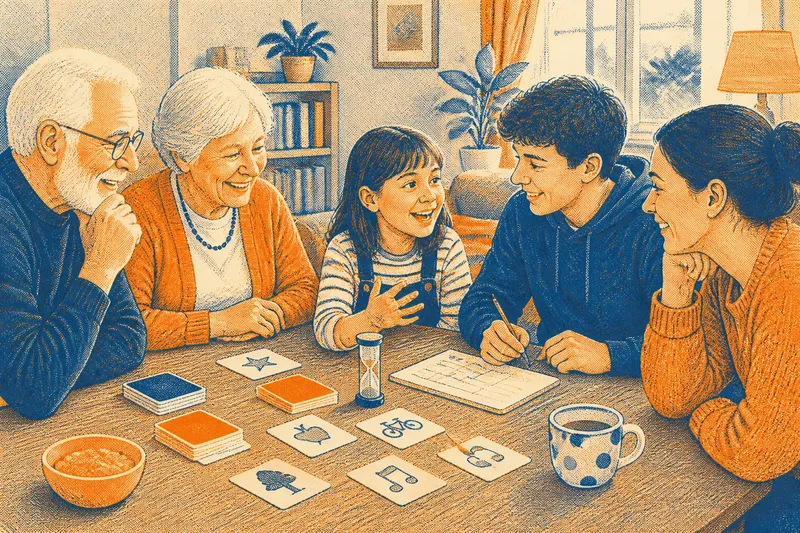
Which game will keep a mixed-age table together without making anyone feel slow? Choosing a board game, card game or word game for a mixed-age table starts with the people gathered, not the box. Consider how they want to spend their time, who may arrive late and whether everyone would rather talk, compete or solve something together.
Which game is easiest to join?
Card games are often easy to join partway through, especially when turns are brief and the rules can be demonstrated as play begins. A late arrival can watch a round, borrow a hand of cards or take over from someone who needs to leave. The table need not stop for a small constitutional ceremony.
Board games tend to have a firmer boundary around participation. Players may need a place at the table, a particular piece and an understanding of the shared board before a move makes sense. That structure can be satisfying, but a newcomer may need to wait until a round ends.
Word games sit between those options. Some invite everyone to call out answers; others rely on individual turns or written clues. A spoken, team-based format can make joining simple, while a game built around private vocabulary or spelling may leave younger players watching rather than contributing.
Ask who might arrive late, leave early or prefer to observe at first. If the group is likely to change, favour short rounds and a clear place for a spare player. If everyone expects to settle in together, a longer board game may suit the occasion.
How do the three formats differ in pace?
Board games usually create a visible, shared pace. Players can see the board change as turns pass, and a move may affect everyone’s plans. This gives the game a sense of progress, though a player who needs time to decide can leave the rest of the table waiting.
Card games can move quickly because the action is compact: draw, discard, play or wait for a turn. Yet speed depends on the rules. A trick-taking game may ask players to remember what has been played; a matching game may feel brisk and forgiving. A small deck does not automatically mean simple play.
Word games vary most in tempo. A fast round of naming things can bring everyone in at once, while a crossword-style challenge may slow to the pace of the person searching for a word. That pause can be welcome. It can also leave the rest of the table watching one player think.
Consider the rhythm the group enjoys. If people want conversation between turns, choose a game that tolerates pauses. If they want a lively burst of activity, use short rounds with frequent chances to act. The right pace leaves room for ordinary talk without making the game feel abandoned.
Which format keeps everyone’s attention shared?
Board games make shared attention visible: the board is in the middle, and everyone can follow the same developing situation. This suits people who enjoy discussing options or working out what might happen next. It is less useful if players become absorbed in separate calculations and stop noticing one another.
Card games direct attention towards hands and turns. Players may be thinking privately, but the table still gathers around a common sequence of plays. Choose a game whose important information is public if you want spectators to follow along. Hidden hands can be fun, but they make casual watching harder.
Word games often give the group a common prompt or answer to work towards. In a team format, different ages can contribute different associations: one person recalls a place, another spots a rhyme and another catches a useful letter. Invite ideas before judging each suggestion, so attention stays with the group rather than one quick answer.
Say you have a table of grandparents, teenagers and a child who likes talking but dislikes waiting. Imagine choosing a team word game with a fresh clue each round. The older players can suggest associations, the teenager can keep track of letters and the child can call out possibilities; the expected result is that each has a reason to pay attention, even without taking identical turns.
How can a game welcome everyone without becoming dull?
Look for rules that are easy to explain but leave room for choice. A game can be accessible without being trivial if players have several sensible options and can see what their choices do. Avoid giving a child a permanent side job; passing out pieces is not participation merely because it involves a piece.
Consider reading, memory and arithmetic demands separately. A box may describe a game as suitable for a broad age range, but that does not tell you whether someone will enjoy reading small text, holding several rules in mind or adding scores. If one demand is likely to exclude someone, choose another format or adapt the task quietly.
Teams can soften differences in experience, but only if each person has a real contribution. Pairing an experienced player with a younger one can help if both discuss choices. It is less helpful if the experienced player makes every decision while the younger partner supplies decorative company.
Keep the first explanation short. Demonstrate one turn, mention the rule that tends to cause confusion, then begin. People often understand a game more readily when they can see its pieces or hear its rhythm than when asked to absorb a recital before touching anything.
Should you choose cooperation or competition?
Choose cooperation when the group would rather solve a shared problem than compare scores. Cooperative board games and team word games give younger and older players a common purpose, and one missed turn does not automatically make someone an obstacle to everyone else’s fun.
Choose competition when the people present enjoy clear turns, individual decisions and a result they can take lightly. A short card game can make a tidy contest. If someone tends to take losing personally, try partners or teams, or choose a game where the result matters less than the changing play.
Neither format is automatically kinder. In a cooperative game, one confident player can take over the group’s decisions. In a competitive game, an uneven contest can become tiresome. Watch how the people at your table respond, and be ready to change the format rather than insisting that everyone enjoy the same challenge.
What should you check before opening the box?
Check the game’s practical demands before guests arrive. Read the instructions where a specific rule matters, then compare the game with the table and the people likely to play. Use these checks to decide whether to open the box or choose something else:
- Number of players: Check the player limit against who is likely to take part; if everyone can play, set it out, but if someone would have to wait, choose a format that includes them.
- Joining point: Check whether a latecomer can enter between turns; if so, keep a place open, but if entry must wait for the round, choose a game with shorter rounds or a fresh restart.
- Attention: Check whether players need to focus continuously; if they do, use it when the group wants concentrated play, but if conversation is the priority, choose a game that tolerates pauses.
- Reading and numbers: Check the cards, clues and scoring for demands that may frustrate someone; if they are comfortable for the group, proceed, but if not, choose a spoken game or simplify the scoring.
- Table space: Check whether the board, cards and players’ hands fit; if they do, set up there, but if not, choose a compact deck or a game that needs no central board.
- Stopping point: Check whether play can pause at a round’s end; if it can, agree to stop there if plans change, but if it cannot, reserve it for a group ready to stay.
- Team choices: Check whether each partner can make a decision; if both can contribute, use teams, but if one person would merely follow another’s lead, choose individual turns or a different game.
There is little value in finding the theoretically perfect game if setting it up takes longer than anyone wants to wait. A familiar deck of cards or a spoken word prompt may suit an evening already under way. The host need not turn a gathering into a demonstration of box management.
What if people arrive or leave at different times?
Pick a card game with complete, short rounds, or a word game that can restart with a fresh prompt. These formats are usually easier to pause and resume than a board game whose pieces and turn order depend on one continuous session.
If you choose a board game, agree beforehand whether a departing player can leave a piece in place, hand over their turn or finish the round and stop. Settling the exit rule before anyone has invested in a long strategy is less awkward than improvising it mid-game.
For a fluid gathering, keep one light game ready and treat a longer one as optional. People can join the first without committing to the second. That is not poor organisation; guests have coats, children, cups of tea and other plans.
What questions help you choose a game for a mixed-age table?
Are card games better for mixed ages?
They can be, particularly when rounds are short and the rules are easy to demonstrate. Check whether the game still feels accessible if players differ in reading speed, memory or familiarity with card-game conventions.
Are word games suitable for children and adults together?
They can suit a varied group when players may answer as a team or offer suggestions without being put on the spot. Choose prompts that allow different kinds of knowledge rather than relying on obscure references or one person’s spelling confidence.
How long should a game last at a gathering?
Choose a format with a natural stopping point before anyone commits to a long session. A short round can be repeated if the table wants more; a game that cannot pause easily is a harder fit for guests with shifting plans.
Can people join a board game after it starts?
Sometimes, but it depends on whether the rules allow an extra player and whether the current board state is understandable. For a late arrival, explain the next turn and essential shared rules rather than replaying the entire game’s history.
How do you decide without overthinking it?
Start with the group’s likely mood. Choose a board game for shared progress and visible choices, a card game for compact turns and flexible rounds, or a word game for talk and collaborative associations. Then check who can join, how much attention the game asks for and whether the table has room.
For a mixed-age table, the best board game, card game or word game is usually the one that gives each person a comfortable way to take part. Keep the rules nearby, explain only what people need to begin and allow the group to stop when conversation has become better than the game. That is a respectable result, though the cards may disagree.